Eight Things I Will Miss About Being A Full-Time White Cane User

I admit it. Me and the white stick have a bit of a rough history. Stories of losing them in rivers and storm drains aside, the canes of my youth were mostly abused in the fact that they were neglected.  I did not often use it as a child and teenager, and when I did it was only in preparation for getting a guide dog as soon as I turned 16. I hated the cane in those days… in fact, I can honestly say I had a healthy disdain for it until quite recently. Throughout my college years, I grew to accept my cane as a useful piece of equipment, but it was still one that I preferred never to use unless forced by circumstance.

Over the last several months though, since I essentially hung up the harness in the spring, my grudging respect for my cane has developed into an all out appreciation, even love.  Yes, I know. People who know me will be falling on the floor in shock at this, but there are things I will actually miss about being a full time white cane user.  Here are a few of them.

1. Sprinting everywhere I go

As a cane user, I get to choose exactly how fast I walk and the fashion in which I walk. I don’t need to worry about paws being stepped on or convince my guide dog that it is more fun to run everywhere. I love being able to grab my cane and take off at high speeds, all while hopping, skipping, dancing, and generally doing something relatively” productive with my sometimes excessive amounts of energy. If you are concerned that this is not safe you are probably correct and will be happy to know that I am picking up the harness handle again in one day’s time. (although when I get that urge to burn off some Shea craziness, the cane is coming out)

2. My Cane Doesn’t Get Distracted

Guide dogs are amazing creatures, but at the end of the day, they are dogs, and they sometimes get sidetracked on the job (squirrel!). My cane, on the other hand, never barks at dogs, lunges after a cat, or goes for food on the ground, and I’ve gotta say, that makes a walk in the park much more like a walk in the park, and less like a rollercoaster ride.

3. My Cane is A Cheap Date

I don’t have to feed, groom, pick-up after, buy toys for, or pay the medical expenses of my cane.  Of course, I am absolutely willing and love to do those things for my guide dog, because it is the least I can do to repay her for the work and affection she gives me, but it *has* been an inexpensive several weeks.  Thanks cane.

4. No dog hair

Man I love having a guide dog, and I love having a dog in general, but it is awfully nice not to have to constantly lint roll and swiffer every inch of my existence to keep myself and my living space looking presentable… my clothes will be covered in yellow or black hair again in a matter of days though, so I obviously don’t care all *THAT* much.

5. No Muddy Paws

My dog goes everywhere with me in all sorts of weather and all sorts of environments… that means muddy paws in wet weather, and paws full of cement dust when we walk through construction sites… neither of which I love when tracked into my apartment.  Easily solved with a damp towel at the door, but not something I have to fool with at all with my cane.

6. Not having to worry about being denied from restaurants and ubers because of my guide dog

Our society has made a great deal of progress with public access for guide and service dog users, but it is still not uncommon for me to experience discrimination because of the presence of my guide dog. That, for me, is not something that outweighs the benefits of having a guide, but it is nice to travel without that worry in the back of my mind. No one is going to stop me from entering a business or Lyft with the proclamation that “no white canes” are allowed, or that they are “deathly afraid” of white canes… at least, it hasn’t happened to me yet.

7. If My Cane Get’s Stepped On, It’s Okay

Public transit, restaurants, concerts, church services, crowded, narrow spaces often mean that paws, tail, and nose are in danger of being stepped on.  Fortunately this only happened a couple of times to Oleta, mostly her paws, but the only reason it didn’t happen more often than that was because I was always hovering over her with my feet and sometimes hands strategically placed to guard her from harm.  My cane doesn’t have nerve endings, so as long as it doesn’t get actually snapped in half, we’re good.

8. Hitting things

Honestly, it’s kind of satisfying to hit things with a 58 inch pole all day.  The tapping and occasional clanging of a cane used to bother me a great deal, but I’ve learned to embrace the aggression and the noise, and sometimes be a bit more noisy and aggressive than strictly necessary, just because:

A. it’s fun,

B. I was a music major and find different sounds interesting, and

C. It makes a particular person in my life really mad, which is hilarious. 🙂

Good news is I don’t have to kiss every one of these things goodbye forever on Wednesday.  The cane, like the dog guide, is a tool in a tool box, and if I feel the need to hang up the harness for a few hours and pick up the cane, I get to do that, and I am glad I appreciate that option now.
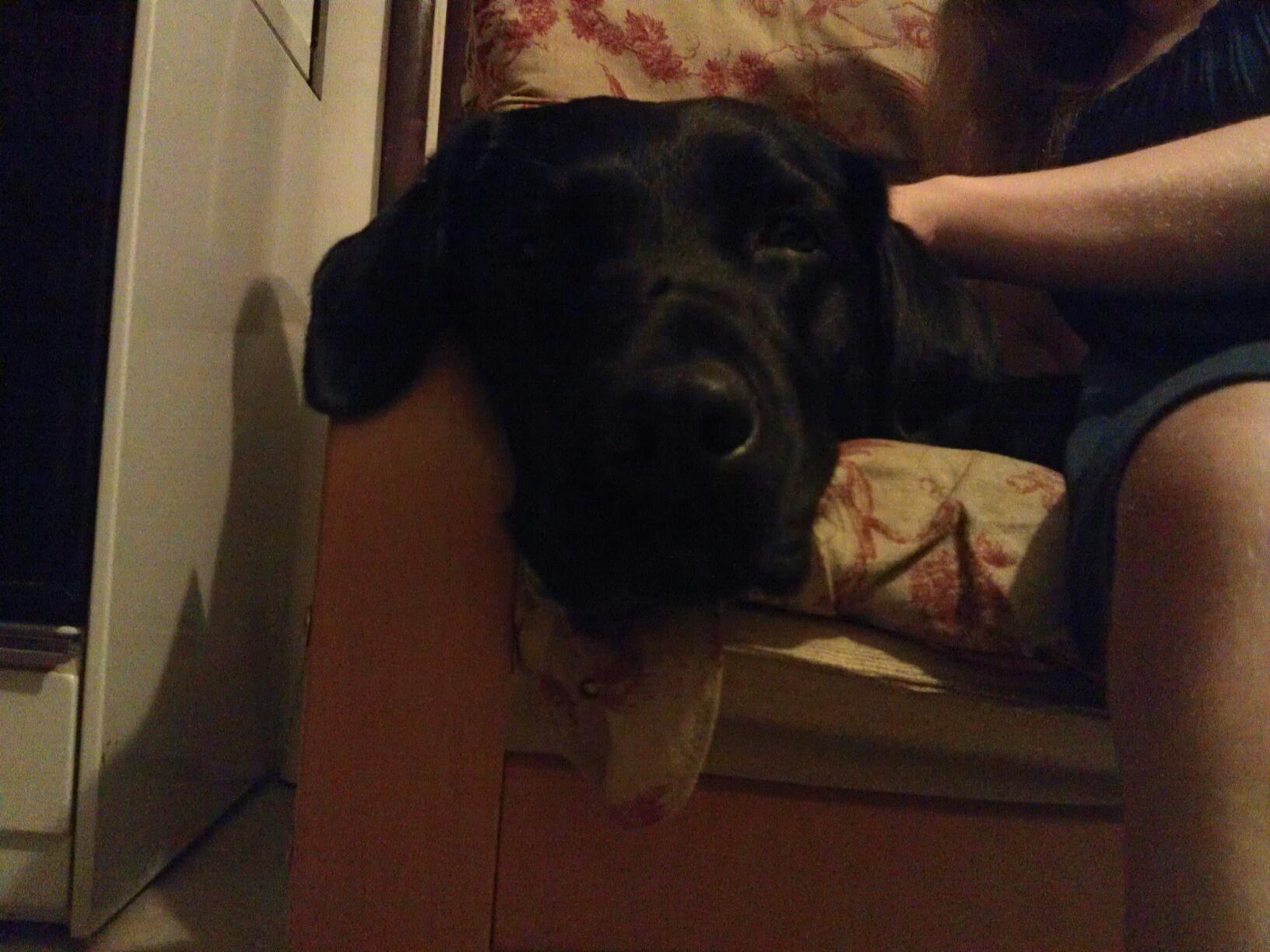
Guiding Eyes Training (September 2017), Day 1

So, let’s start with the basics.  I am blind, and as a blind person, I use a cane, but I, for many reasons, choose to live my life with a guide dog in addition to having the option of my white cane.

If you are curious about some of my reasons for choosing to be a guide dog user, see

this post.

A guide dog is a live animal.  They are not machines.  They go through two years of training before ever laying eyes on their blind partner, and then 2 weeks to a month of training with their human.  At Guiding Eyes, the standard training program is 21 days.  During this period of time, the student learns verbal commands, hand signals, and training techniques in order to work effectively with their trained dog.  The dog and human both have to become familiar with one another’s body language, and learn how to work with one another in a variety of different environments, including indoor and outdoor, urban, suburban, and rural areas, as well as public transit.  This is what I will be doing for the next 21 days at the Guiding Eyes campus in Yorktown Heights, New York.

So, without further introduction, (drumroll please!) I have arrived in New York!  The trip to and through the airport was a breeze.  Our flight went incredibly quickly, as we arrived 30 minutes early.  I met two Guiding Eyes staff near baggage claim and met some of my classmates as they arrived.  As we waited and later as we traveled to guiding eyes in the vans, we chatted about our guide dog experiences, blindness, canes, and our home lives.  It’s funny how an experience like this draws a group of people together so quickly.  My classmates are already teasing me for being hyper, giggly, and speedy.  I even had someone tell me they could hear my southern accent, which surprises me since I did not think Tennessee had affected my accent at all.  We have representatives in our class of 13 students from at least 8 states, according to my research thus far.

When we arrived to campus, we found our rooms and met our instructors.  We have three instructors, as well as a class supervisor (who happens to be the same person that trained Oleta and myself in 2011), a special needs instructor, and two instructor assistants.  The last time I came, there were only two main instructors, a class supervisor, a special needs instructor, and one instructor assistant, so the trainer to student ratio has improved.

I first went to lunch, because I was starving, and got to see and converse with some people I remember from July 2011.  I took the 30 minutes or so after that to explore my room.  There is an empty crate, hooks on the door for a harness, and a container with dog food, two bowls, a measuring cup, and a bone.  There will be a puppy after all!  I cannot believe it!

At 3:00 Pm, we had building orientation, followed by dinner at 5:15 and evening lecture.  The building has changed a bit since I was last here, but I was happy to find the baby grand piano still in it’s corner in Alumni Hall.  That, I think, will be the way I distract myself from the waiting Tuesday evening.  Lecture covered GEB expectations for student conduct, the general daily schedule and other house keeping info, and equipment.  We received orientation to the harness, martingale collar, training collar, and leash.  I will explain equipment for y’all more in detail in another post.  We also received our very own new leashes!  They are shiny and much stiffer even than I remember.  Soon I will be clipping that leash to an actual real live dog!!!  I wonder who it will be!

Training with my Second Guide Dog

And so it begins. Just as there was a second journey recorded on this blog in Scotland absent of Oleta, my darling first guide dog, here commences yet another second journey in her absence, that is, my second experience at guide dog school, and a new partnership with another wonderful Guiding Eyes dog. I plan to keep a careful account of my training and related musings in the pages of this blog. My hope is that it will prove useful both for me as an opportunity to reflect on the things I am learning and feeling throughout the process, and for others who want to discover more about guide dogs and guide dog training. When I was a teenager preparing for my first guide dog at 16, I scoured every website I could possibly find related to guide dogs. Training blogs like this were one of my favorite ways to learn more about guide dogs in general, as well as specifics about the varied training philosophies and programs in existence.  If this account is as interesting to someone else as similar blogs were to me as a first time applicant to guide dog school, I would be humbled (and also impressed that your attention span is that long because seriously I am a wordy writer.  Haha. Prepare yourself!)

See you in New York!

Reflections on my First Guiding Eyes Journey – Meeting my Little One with Wings

I found a seat in the circle of chairs in Alumni hall along with my classmates. I was full of lunch and laughter and bursting with the excitement of it all. I had dreamt of getting a guide dog for years, and this was the moment. I was about to discover the identity of my long-awaited companion. I sat on the edge of my seat as our meeting commenced.  A few people spoke first — my class supervisor, the president of the organization, saying a few special words about the journey we were about to undertake.  Until, finally, it was time.  We all waited with bated breath as our class supervisor read the first name.

“Miss W, It’s your birthday so we’ll start with you.  Your dog is named Paulson, P-A-U-L-S-O-N, and he’s a yellow lab male.”

She continued from Paulson, a yellow lab male, to Lynn, a yellow lab female, to Pacer, Orlando, and Butch, all yellow lab males, among others.

As the names and breeds passed, I evaluated each one.  Did that dog’s name match with the name of their handler?  Would I like having a dog named that?  Oh dear, what would my dog’s name be anyway?! What if I hated it?  Would I get a boy or a girl?  It seemed like we had a lot of yellow lab males… maybe that’s what I would have too… but then it was my turn.

“Shea,” A pause that seemed like eternity.  “Your dog’s name is Oleta, O-L-E-T—A, and she is a black lab female.”

A sound that was half laughter half sob escaped me at hearing her name.  It was so beautiful I thought I was going to cry right there.  My classmates laughed at my reaction and encouraged me to breath.  I tried, but couldn’t.  Oleta!  I was already in love with her!

After the rest of the class received their match information, we all went back to our rooms to wait… and wait… and wait.  I curled up on my bed trying to distract myself with Facebook and reading my bible, but nothing was working.  All I could think about was Oleta.  Would she like me?  Would we be able to work together?  What was I going to do for the next two hours of bonding time?  What if I did something wrong and ruined all her training?  Could I really stay calm and collected when she arrived like our instructors told us we should be?

I perked up every time I heard a sound in the hallway.  Footsteps?  It must be my trainer coming to my room! But no.  They continued past, probably headed to a fellow students room to deliver their pup.  The jingle of a collar or a leash?  That had to be Oleta! I thought, but no.  It was someone else’s dog.  Voices!  I was sure it was my trainer with Oleta! But no… it was my neighbor receiving her dog.  I must have started toward my door to open it three or four times, before I finally surrendered to the agonizing wait.

At long last, an hour or so on, a gentle knock sounded, and I slid quickly from my bed to go get it.  Leash in hand and treat pouch appropriately placed, I reached for the door handle.

“Hi Shea.” My instructor greeted me, calmly. “Here is Miss Oleta for you.”

Wet nose, velvety fur, thwacking lab tail, and kisses galore.

“Hi Oleta!” I crooned, giving her a greeting scratch and welcoming both she and my trainer into my room.  I reached into my treat pouch and offered her the three, high-value food rewards our trainers had given us to make a good first impression on our new partners.  My hand was shaking, and thoroughly washed, as she gobbled up each treat in turn, and then made absolutely sure there weren’t any remaining morsels in my palm.  At discovering there weren’t, she turned her attention to the floor.

“Okay.” My trainer said.  “I’m gonna take my leash off and you can clip yours to her collar.”

I did, and just like that, Oleta was mine.

“She’s all yours.” My trainer confirmed, as she moved to the door. “Enjoy her.”

Puppy Poll!!! — You Tell Me, Who will It Be?

Getting a new guide dog is rather like having a baby… there is a long period of waiting, and then that exciting moment you realize it’s actually happening, and then more waiting, and all the time, you are wondering… will it be a girl or a boy? What will she look like? What will her name be? Will he be calm or energetic? Clingy or independent? Focused or playful?

In this case, I can’t help thinking about whether he will be like Oleta, my retired guide.  Will he knock me over with kisses the first time he meets me like Oleta did, or be a bit more reserved? When we go out for training, will she step daintily into the van like Oleta did, or leap enthusiastically after me, like some of my classmates dogs did in 2011?

At the moment, I can’t answer any of these questions… but what I can do is have some fun with it.  So, let’s speculate.

What’s your vote?

Celebrating Five Years

With the cool evening air wafting in through the screen door, along with golden birdsong and the smoke of summer fires, I am swept into years past, happy childhood years, filled with summer evenings of s’mores and sparklers. Today has been a day of reflecting on memories. That’s because today marks 15 states, 4 countries, 5 languages, five years, and countless memories since Oleta, my beautiful guide dog, and I became a team.
Contrary to many people’s assumptions, I don’t NEED a guide dog to travel independently. I can (and do upon occasion) use a white cane to travel just as effectively. I don’t NEED a guide dog to pursue my professional goals. I know lots of blind professionals who are strictly white cane users. I chose to work with a guide dog because I loved dogs, I imagined working a guide dog to be infinitely more pleasurable than using a cane, and it was, after all, my dream to have a guide dog from the age of eight.
Those reasons still stand. Working a guide dog is, in my opinion, infinitely more pleasurable than using a cane. A guide dog allows one to walk much more fluidly and quickly without having to stop every 20 feet to unstick one’s stubborn cane from the side walk, or the grass, or some unidentifiable metal thing in the middle of the path, or, heaven forbid, someone’s legs, or to recover from getting one’s cane stuck in one of these various and sundry obstacles, not stopping fast enough, and promptly being rewarded with a sharp jab to the stomach. Yep, don’t miss those days. Having a guide dog also means that I didn’t get hit by that one insane bus driver who suddenly decided to drive on the side walk right where I was standing, it’s a heck of a lot easier to find doors, stairs, curbs, escalators (Oleta LOVES escalators), benches, etc, and sometimes even one of my best friends. Yes, these, among others, are all awesome benefits of having a guide dog, but now a days, the reason I work a guide dog is because of Oleta.
Oleta, who loves unconditionally as easily as she licks, who takes work breaks to wriggle on her back in the grass and the snow and the sand just for the pure joy of it, who actually whines when she sees children on playgrounds because she wants to play with them, who lives out the meaning of her name “Little one with wings” every time we find ourselves flying alone along some sidewalk or other.
Dear Oleta, I love how you love life, and I love living life with you. Happy five years of memories made! I look forward to many more together.

6 Ways PETA Got It Wrong About Guide Dogs

The following is an actual quote from PETA’s one-time VP from an article in LA Unleashed…

“There will never be a perfect world, but in the world we’re in now, we support some working dog situations and decry others.  Hearing dog programs that pull dogs from animal shelters and ensure that they are in safe and loving homes have our stamp of approval; they live with the family for their entire life, they learn interesting things, enjoy life, and love helping.  On the other hand, we oppose most seeing-eye-dog programs because the dogs are bred as if there are no equally intelligent dogs literally dying for homes in shelters, they are kept in harnesses almost 24/7, people are prohibited from petting or playing with them and they cannot romp and run and interact with other dogs; and their lives are repeatedly disrupted (they are trained for months in one home and bond, then sent to a second, and after years of bonding with the person they have “served,” they are whisked away again because they are old and no longer “useful”). We have a member who is blind who actually moved states to avoid “returning” her beloved dog. We feel that the human community should do more to support blind people, and give dogs a break.  A deaf person can see if a dog has a medical issue such as blood in her urine, a blind person living alone cannot, and so on.”

As a real live, everyday guide dog user, I can testify that:

  • 1. Hearing dog work is VERY, VERY different from guide work. In general, it is a much less stressful job to do. Guide dog work requires a confident, sound dog that can work through any number of unpredictable and potentially dangerous situations in any number of environments. From working through large crowds in stores or train platforms, to intelligent disobedience (refusing to obey a command when it might put the team in danger, AKA, blind person tells dog to go forward when there is a car coming), to riding cars, buses, trains, and planes without incident, to staying cool in emergency situations (AKA fire alarms, hurricanes, tornadoes, I mention those three because Oleta and I have experienced all three together), to resisting the temptation to chase squirrels, pigeons, or food while in harness, not any dog can deal with that sort of stress, and no one wants to force a dog who is easily frightened and unhappy in a position that he does not want to be in, especially when that places the life of the blind person he is paired to in danger as well. Guide dog puppies are bred specifically for this work, spend their entire puppyhood preparing for it through socialization and positive experiences, and those who pass the test and are partnered as guides are in the absolute happiest place they could be. As much as all of us would like to be adopting dogs out of shelters to use as guides, most shelter dogs are not bred or conditioned to handle such high demands of their energy, intelligence, resilience, and skill, and would not be happy or successful in harness.
  • 2. Guide dogs are NOT in harness 24 hours a day!!! Aleta is in harness when we are on route, but she is off harness full time while at home, and many times I remove her harness in class, studying at the library, practicing in the practice rooms, etc. While in harness, she is not allowed to associate with other people or dogs, but she is absolutely allowed to associate with me, and I give her plenty of love and interaction. When off harness, Oleta gets tons of attention from me, my roommate, my family, friends, and classmates… many say they couldn’t imagine a more well-loved dog.
  • 3. When off harness, Oleta gets tuns of time to run and play by herself, with humans, and when we can arrange it, with other dogs too. She loves to play with another guide dog on campus, and they get along great. She has all sorts of toys, but her favorite thing to do is sprint laps in our dorm hallway. I bet most pet dogs don’t get as much room to run in the house as she does in our dorm.
  • 4. When Oleta makes the decision to retire (and it is the dog’s decision), she will not be “whisked away because she is too old and no longer useful”. The dog will let you know when they need to retire, through any number of factors, and when that day comes, the handler has the choice to keep the dog as a pet, give them to a trusted family member or friend to be cared for in their retirement, return them to their puppy raiser, or get help from the agency to adopt them out to a loving home. My first choice would absolutely be to keep Oleta forever, but it might not be possible or in her best interest to do so based on my living situation and schedule. After a guide dog retires, they are no longer considered service animals, and public entities are no longer required to accommodate them. If I were living in a dorm or an apartment building that did not allow pets, Oleta could not stay with me in her retirement. It breaks my heart to think about, but in that case Oleta will spend her days of retirement with my family, whom she is familiar with and would be comfortable living with. My third choice would be her puppy raiser, whom she would also remember. Whatever happens, Guiding Eyes will support me in whatever decision I make. It would take serious accusations of abuse or breach of contract for Guiding Eyes to take Oleta from me, especially since the client can sign for ownership of the dog after a number of months of ownership. Guide dog schools do not take dogs away from clients willy nilly without their permission.
  • 5. Humans cannot replace the work that guide dogs do every day. The entire point of a guide dog is to provide greater independence to we blindies without human assistance, because no, I do not want to be led around by some human guide. It would be demeaning and far beyond inconvenient, not to mention unnecessary. I can get around perfectly fine without either human or dog using my cane. I would much prefer a cane to a human guide, but I would much prefer a dog to a cane.
  • 6. Blind people are extremely in tune with their guide’s bodies and can detect a health issue just as easily, sometimes more accurately, as a sighted person. It is possible that we may miss some visual symptoms, which is why we take preemptive measures to keep our guides healthy through good nutrition, exercise, teeth brushing, ear cleaning, preemptive medications/vaccines, etc, and by making regular visits to our vet. Oleta has had one serious health issue in the nearly five years we have been together, and I recognized it before my sighted roommate. Sure, I can’t see, but I know my dog, and I know when she’s sick.
  • Even more than that, my relationship with Oleta is one that goes far beyond that of person and pet. We have weathered storms and traffic stops and sophomore slump together, attended thousands of lessons and lectures, traveled nationally and internationally, gone to disney World and Busch Gardens and Hershey Park, participated in two graduations, spent nearly every day and night of these last four and a half years watching and wishing and wandering together. When Oleta isn’t at my side, I feel two dimensional, like part of me is missing, and it’s true, because Oleta is part of me.
    I think PETA’s arguments here PETAred (hahaha, get it?) out a long time ago, but I thought we might as well tackle the issue, just in case. Consider yourself educated.

    Breaking Booties (By Oleta Renee)

    You’ve seen me in them multiple times this week, and yes, it’ll keep happening… It’s the same comment every time. “Aw, that dog has little shoes!”

    There are two problems with this… no, three.

  • 1. They are called booties, not “little shoes’. I make this distinction because
  • 2. ‘Little shoes’ sounds cute. They are not cute. It’s easy to become confused, I’m sure, considering my high level of fashionality, but they are part of the job. They protect my paws in extreme temperatures (both hot and cold), and from salt and chemicals on the road in freezing conditions.
  • 3. Also, they are highly uncomfortable. We dogs are built much sturdier than you humans, and while getting salt stuck between your paw pads or dancing on street corners because of the heat is definitely unpleasant, I almost prefer it to wearing such a ridiculous form of attire. During booty season, Shea is fond of telling me, “Oleta, it’s really not that bad. I wear shoes every day!” But here’s the thing… I don’t!
  • Admittedly, there is one slight benefit to wearing booties. They give me all kinds of traction… which means wherever I want Shea to go, she goes. Now, I don’t take advantage of this very often. Usually, it’s helpful to keep both of us from sliding on ice, and so much more fun than slipping around on the slick tile in those college buildings of ours… at dinner time though… we’re goin’ home, and with my four-paw drive, there’s not much Shea can do about it. Hey, don’t judge me… this is a give and give relationship. Shea gives me booties, I give her attitude. Fair is fair.

    That said, booties are part of guide work, and I love my job, so as much as I detest them, I will keep wearing them for the sake of keeping Shea safe… don’t tell Shea I said that though.

    P.S.
    The title of this post is, yes, a play on the show title “Breaking Bad’, because my chosen career is so bachelor of arts (BA) in general, but it’s really more about my sincere desire to actually break my booties. Just thought I should clarify. Until next time, over and out.

    Need Some Expert Testemony? (By Oleta Renee)

    Wow… It’s been a while, but Shea is currently working on a speech, and ignoring me I might add, so I thought I might contribute to the blog, since she’s been such a terrible blog authoress (blauthoress? I like it.) She’s been a terrible blauthoress, so I’m lending a paw to the cause.
    The speech on which she is currently working happens to be on the subject of guide dogs, a subject on which I happen to be well versed. Her professor is always talking about how one should have “expert testimony” to support their claims. She is concerned, because she was crazy this week with midterms and didn’t have time to call and interview a guide dog trainer as she wanted to do, but I think she is missing a crucial detail here. SHE literally lives with an expert on guide dogs and guide dog training! Hello… why bother calling a human guide dog trainer when you can just interview the guide dog? Sometimes Shea makes no sense!
    So, I just wanted to let you guys know, if you ever need some expert testimony on guide dogs, I would be more than pleased to offer my expertise.
    Professionally,
    Oleta Renee

    Hi! I’m… Who am I exactly? (By Oleta Renee)

    So here’s the thing… in trying to introduce myself, I realized I’m in a bit of an identity crisis.

    I am originally from New York, Patterson, New York to be exact, and I grew up with my AWESOME puppy raiser around there, but I’ve heard through the grapevine (that is to say Shea and the people we meet on a day to day basis) that labrador retrievers as a race (breed is so demeaning) began in Newfoundland, whereas Newfoundland dogs claim they are routed in Labrador… weird!  So, really, should I even be calling myself a labrador, if we came from Newfoundland, and am I Canadian, or American?  But then, people don’t talk about American or Canadian labs, they talk about American or British labs, which makes no sense at all!  So, am I American, Canadian, or British?  And shouldn’t they be talking about American, Canadian, and British Newfoundlands, not labs? 

    People tell me I’m an American Lab (Newfoundland?), which basically means I’m stunningly gorgeous in comparison to those stocky, blocky, British labs.  I am inclined to agree with them.  THere’s no doubt I’m slim, trim, and looking American, right down to the stars and stripes pin on my harness.  Besides, no offense to Canada or England, but America is the best.  I’ll have to expand on that in a future post.

    So, with that decided…

    Hello, my name is Oleta Renee, and I am a black, American labrador retriever, except I’m actually a labrador guide dog.  Shea is my person/Mom/best friend/partner in…er…completely legal activities.  I have earned my doctoral degree in guide work (attained at the acclaimed University of Guiding Eyes for the Blind in Yorktown Heights, NY), and went back to receive a human high school diploma with Shea.  I am now currently studying music, with a minor in squirrel management and dog therapy at Shea’s university in Nashville.  By the way, fellow educated canines, if you are thinking about getting a degree in squirrel management, my university is a great place to do it… a lot of practical experience.

    Anyway, you will come to know me and more about my work as I post along with Shea on our blog.  I look forward to getting to know y’all as well!  Guide dog friends, make sure you drop in so we can swap guiding tails (see what I did there?).  

    Off for a frappuccino on the patio with Mom.  (What? You don’t think she’ll give me a sip?)Image